

LawFlowHQ
The Problem
Most practice-management software is built for law firms in New York or London — priced in dollars, billed by card, and completely blind to how money actually moves in Kenya. Here, firms run on M-Pesa. Fee notes get paid by STK push, receipts arrive as SMS, and reconciliation happens by hand in a spreadsheet at the end of the month.
We saw a gap worth building for: a serious, modern platform that treats the Kenyan legal market as the default, not an afterthought. Not a foreign tool with a currency toggle — a system where KES pricing, M-Pesa collections, and local practice are designed in from the first line of code.
So we built one. LawFlowHQ is a Rhetoric Group product: a multi-tenant SaaS that brings clients, cases, documents, deadlines, and billing into one workspace — and connects the last, hardest mile of running a firm, getting paid, directly to M-Pesa. This wasn’t a client brief we executed. It was a market thesis we backed with our own product, design, and engineering, and took all the way to launch.
How We Solved It
We approached LawFlowHQ the way we approach any Rhetoric Group product: as a business first, a product second, and a codebase third.
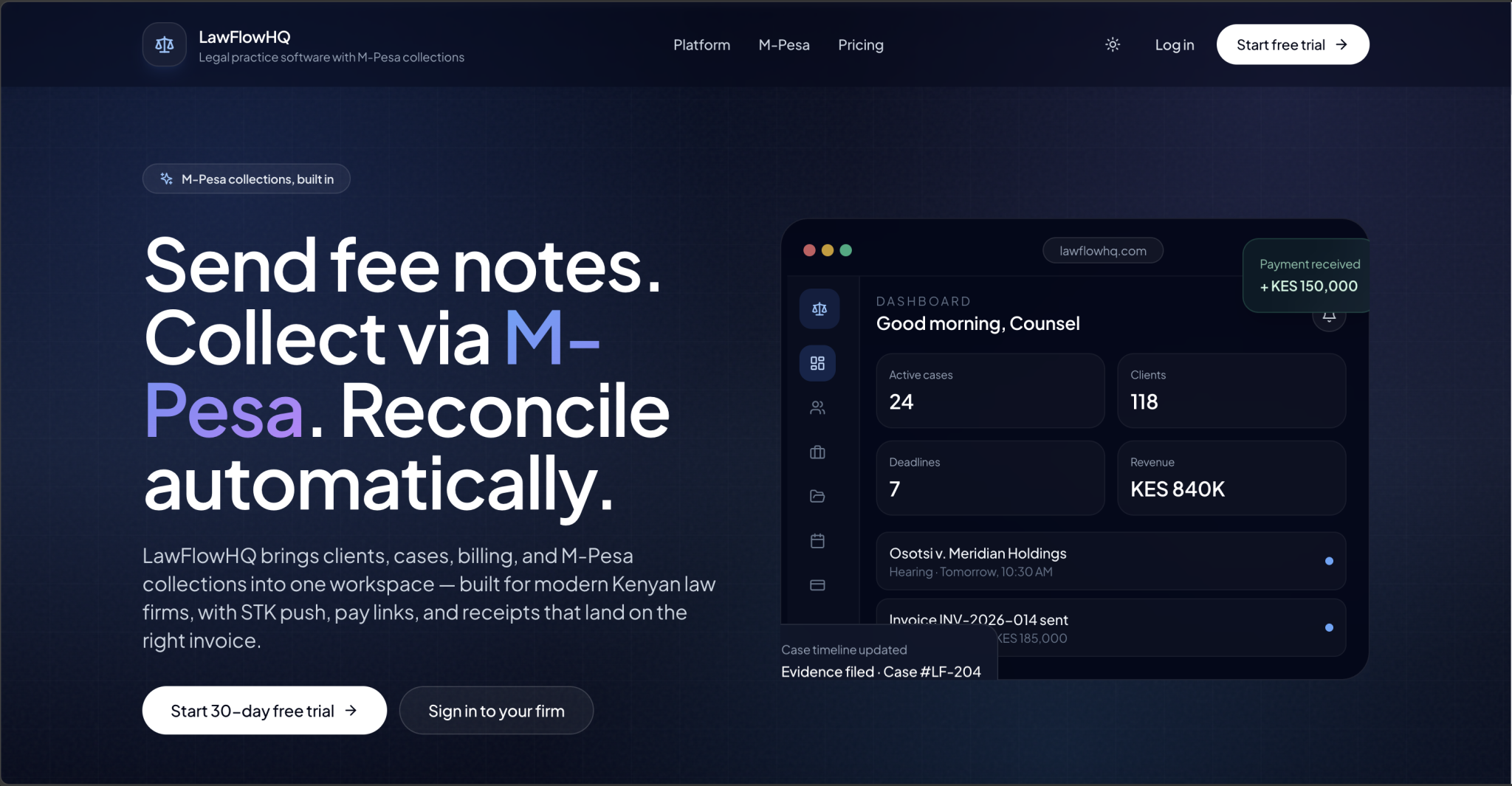
We started with the operating reality of a Kenyan firm and worked backwards. The core insight shaped everything: collections should never leave the invoice. A fee note, an STK push, and a receipt shouldn’t live in three different places — they should be one continuous flow that reconciles itself. That principle became the spine of the product, expressed on the marketing site as a single promise: send fee notes, collect via M-Pesa, reconcile automatically.
From there we designed a true multi-tenant architecture — every firm gets an isolated workspace on its own subdomain, with its own data, team, branding, and Safaricom credentials — and a clean, opinionated application layer on top of it. The result is a platform that feels less like legacy legal software and more like a modern product a firm actually wants to open every morning.
Key Decisions Made:
- Kenya-native by design, not by localisation
- KES invoicing, M-Pesa collections, and local practice patterns are first-class, not bolted-on. The product leads with the thing incumbents ignore: how firms in this market actually get paid.
- Collections that stay on the invoice
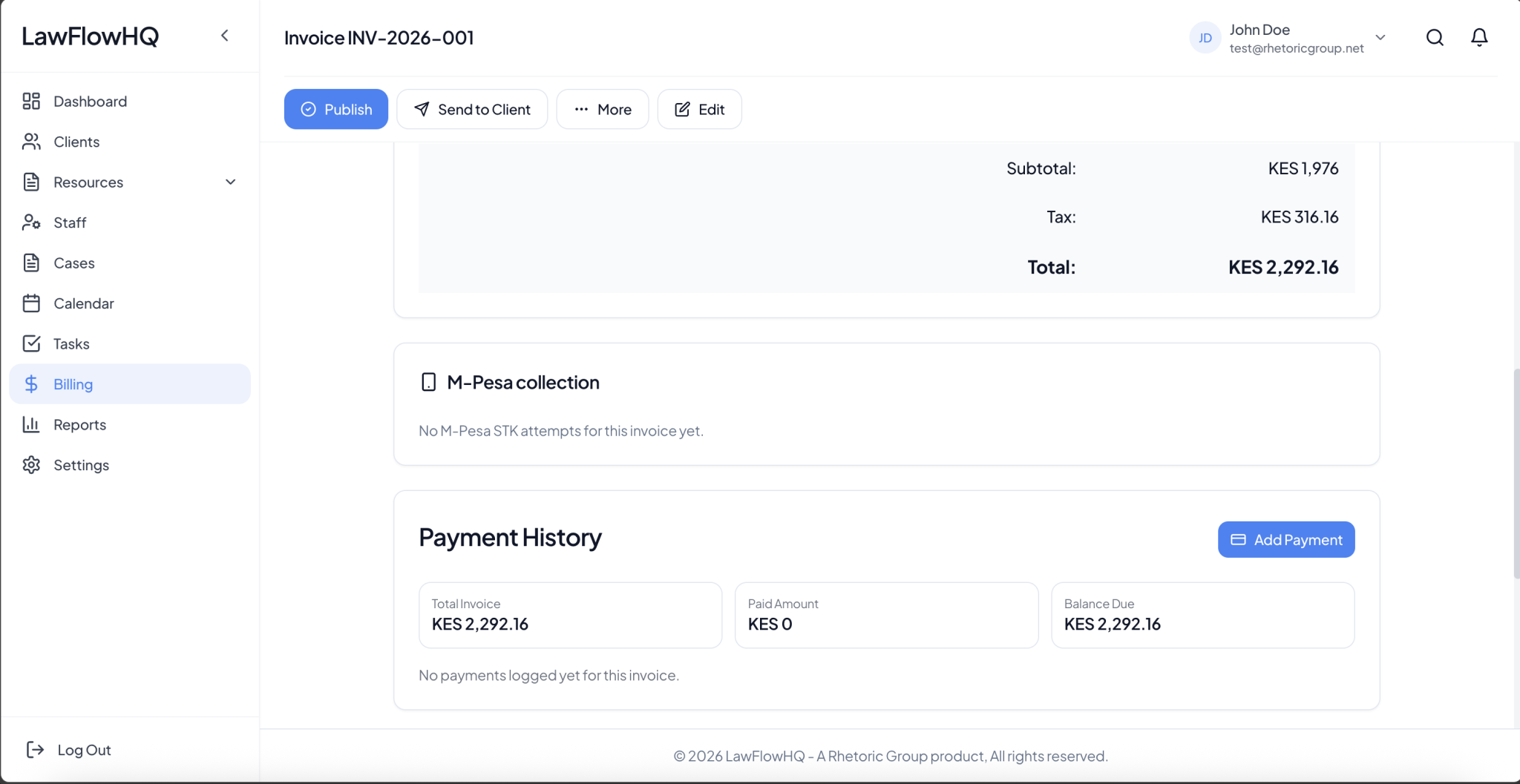
- A fee note flows into an STK push (or a one-click public pay link), and Safaricom Daraja callbacks mark the invoice paid, record the receipt, and update the collections view automatically. No manual receipt-chasing, no month-end spreadsheet.
- Genuine multi-tenancy
- Each firm operates in an isolated workspace under its own subdomain, with strict per-tenant data separation, its own team and permissions, and its own payment credentials — so there's no shared M-Pesa pool and no data bleed between firms.
- One workspace, not a patchwork
- Clients, cases, documents, calendar, tasks, staff, billing, search, and reporting are unified in a single application, replacing the usual stack of disconnected tools with one coherent system.
- Self-service growth engine
- A public marketing site, a multi-step signup wizard, and a 30-day trial let a firm create its workspace, invite its team, and start running matters without a sales call or a developer.
- A platform behind the platform
- A separate admin console gives us tenant provisioning, subscription oversight, analytics, storage monitoring, audit logging, and secure support-access — the operational backbone required to actually run a SaaS, not just ship one.
- Product-grade craft throughout
- A refined, responsive interface with light/dark theming, motion, accessibility passes, and a guided onboarding tour — the level of polish we'd expect from a top-tier product company, applied to a category that rarely gets it.
What We Built
We designed, engineered, and launched a complete SaaS product end to end — from the marketing site a firm first lands on to the billing engine that collects their fees.
The firm workspace
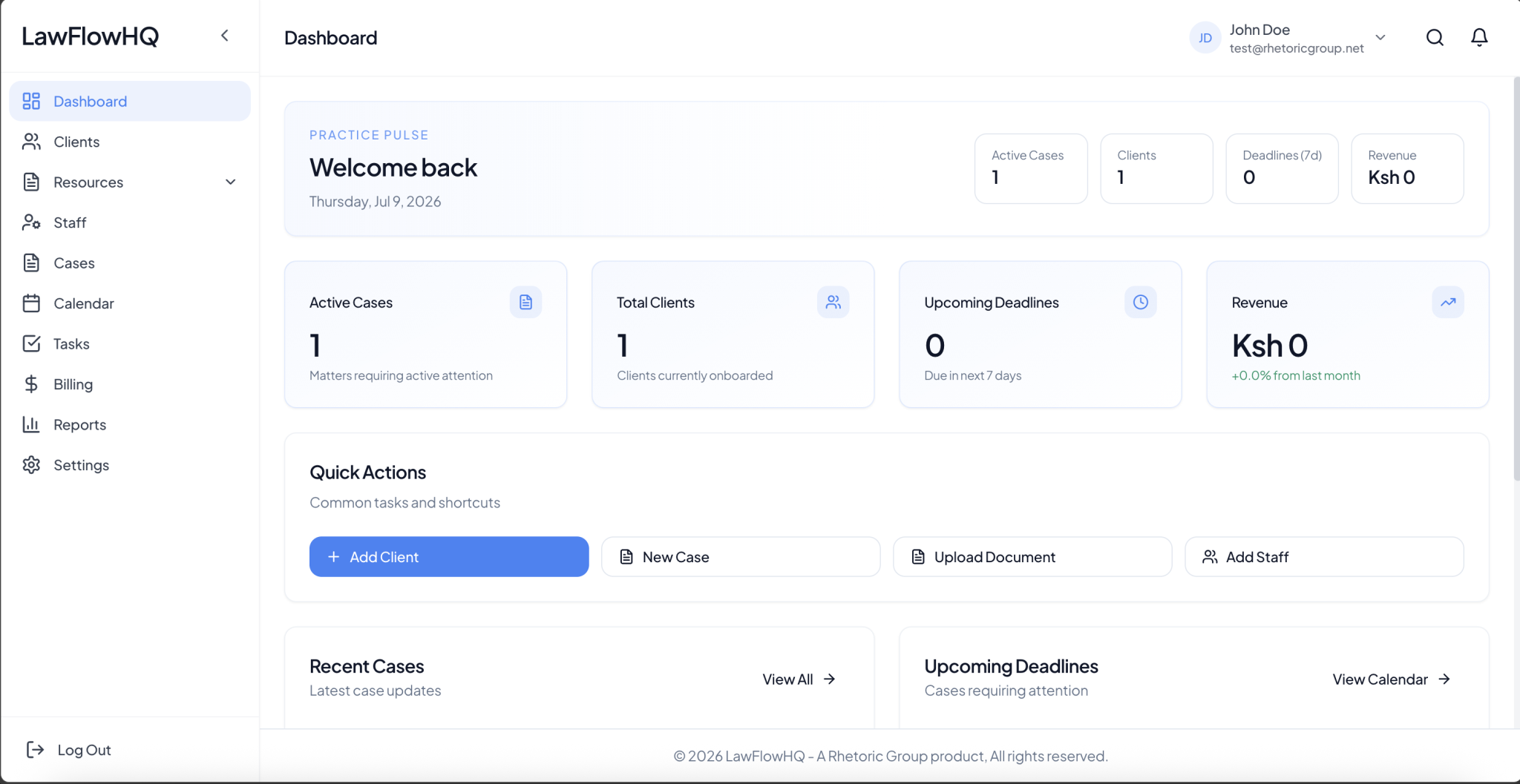
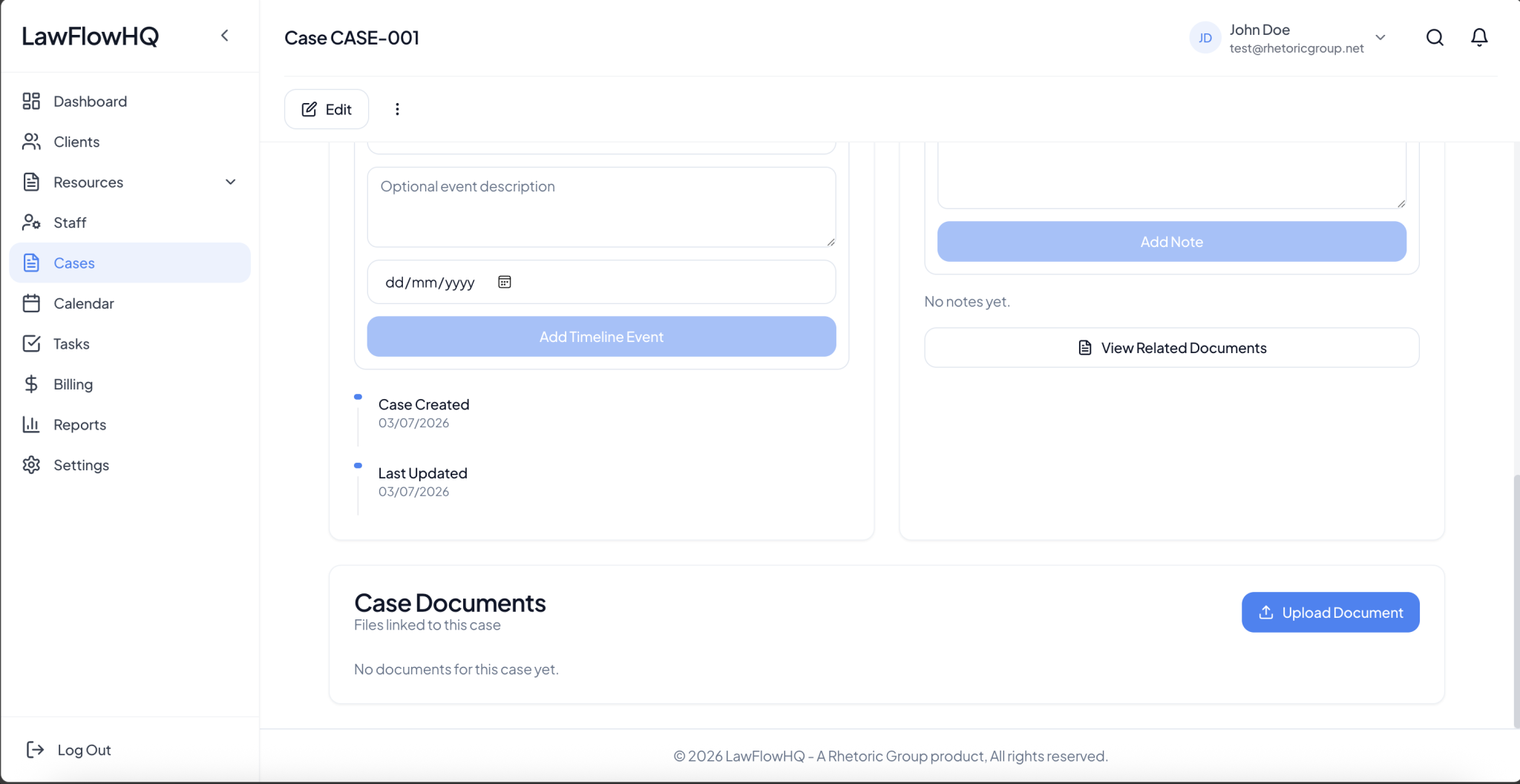
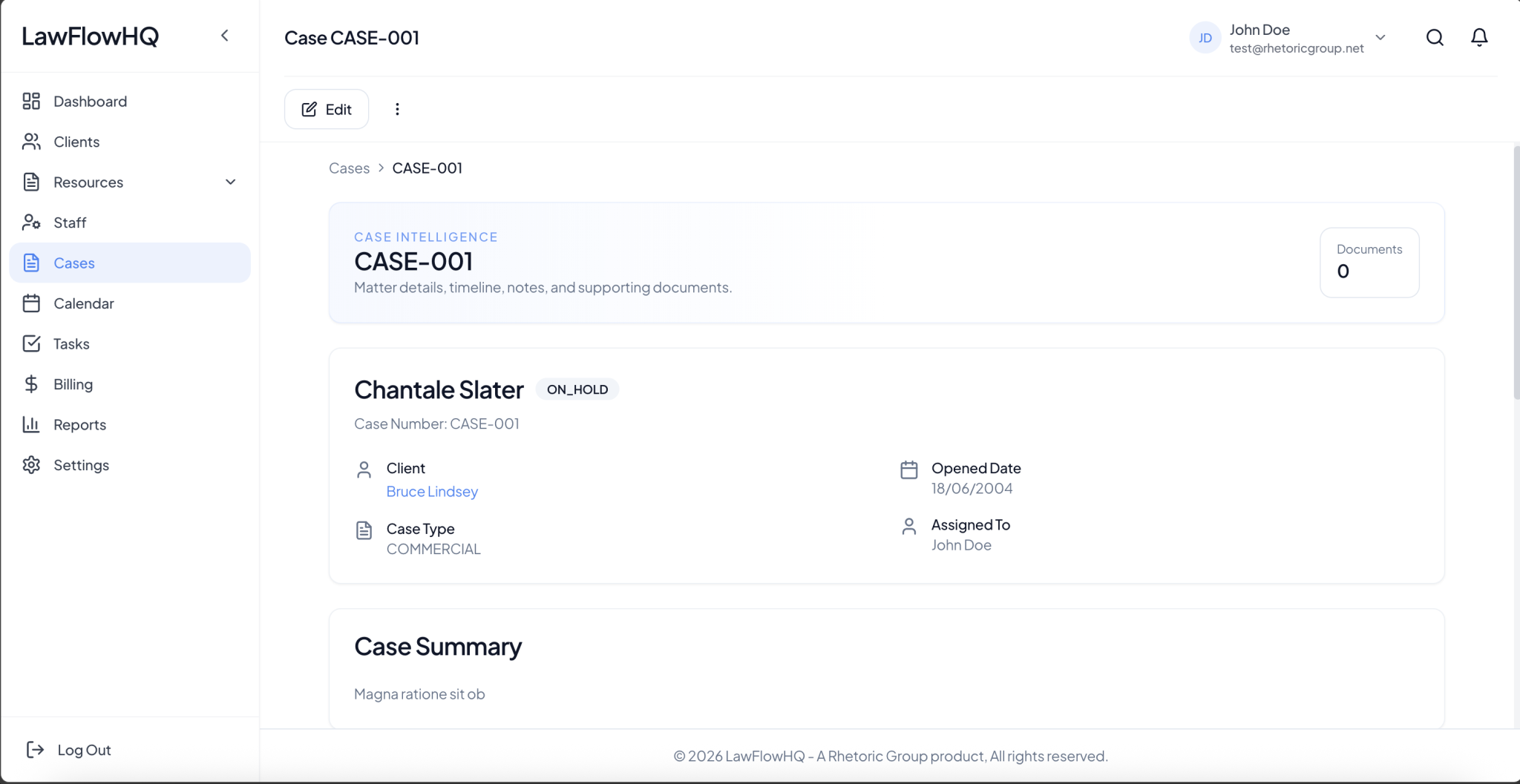
A unified application covering the full arc of running a practice: a live dashboard, client and case management, documents with folders, sharing, and previews, a calendar and task system, staff and permissions, global search, and in-app notifications. Every module is fully integrated with the platform’s API — this is a working system, not a prototype — and presented in a clean, modern interface that stays fast and legible on any device.
The collections engine
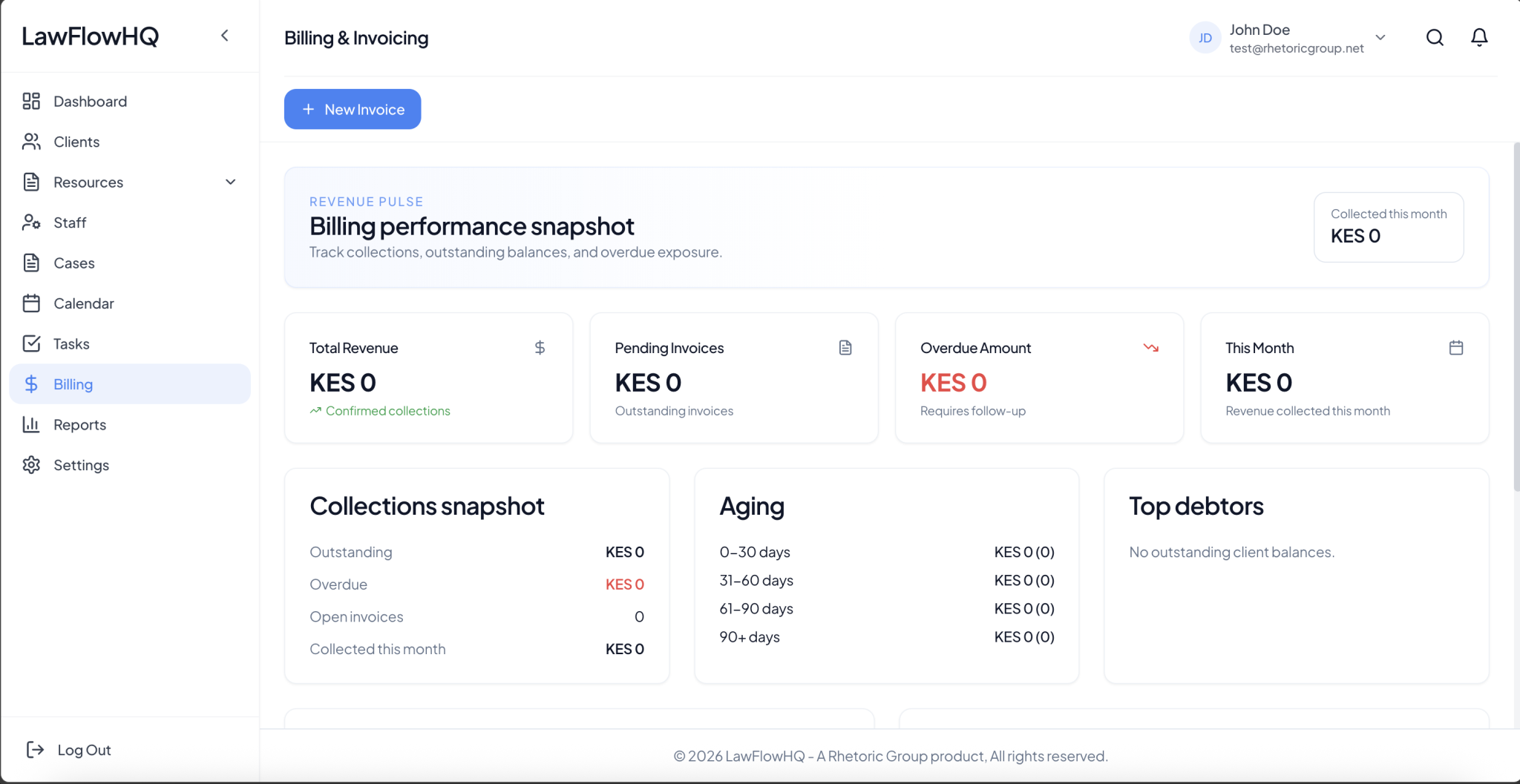
The heart of the product. Firms raise professional, KES-denominated fee notes, then collect through M-Pesa STK push from the dashboard or via public pay links they can send to any client. Payments reconcile themselves against the right invoice, with receipts and a live collections view — including aging — so the firm always knows exactly who has paid and who hasn’t.
The platform layer
Behind the tenant app sits the machinery of a real SaaS: multi-tenant provisioning, subscription plans and billing, self-service signup with spam protection, transactional email, a full platform-admin console, and monitoring for the health of the business itself.
Commercial model
Three transparent tiers — Starter, Professional, and Enterprise — scaling by team size, storage, and capability, with a no-credit-card 30-day trial as the front door. Pricing, packaging, and feature gating are built into the product, so the commercial model and the software are one and the same.
In short: a production, revenue-ready SaaS business — product, platform, payments, and go-to-market — conceived and shipped in-house.
Outcomes
The collections gap, closed
Fee note → M-Pesa → reconciled receipt runs as one automated flow, removing the manual reconciliation every Kenyan firm currently does by hand.
True SaaS foundations
Isolated per-firm workspaces on their own subdomains, with per-tenant data, teams, branding, and payment credentials — architecture that scales to many firms without compromise.
Self-service from day one
Any firm can go from landing page to a live, branded workspace with its team inside on a 30-day trial, with no manual setup on our side.
Commercially complete
Tiered pricing, subscription billing, trials, and feature gating are shipped — the product can acquire, onboard, and bill customers on its own.